
Seasonal Produce Calendars Explained: How Growing Cycles Affect What You Pay

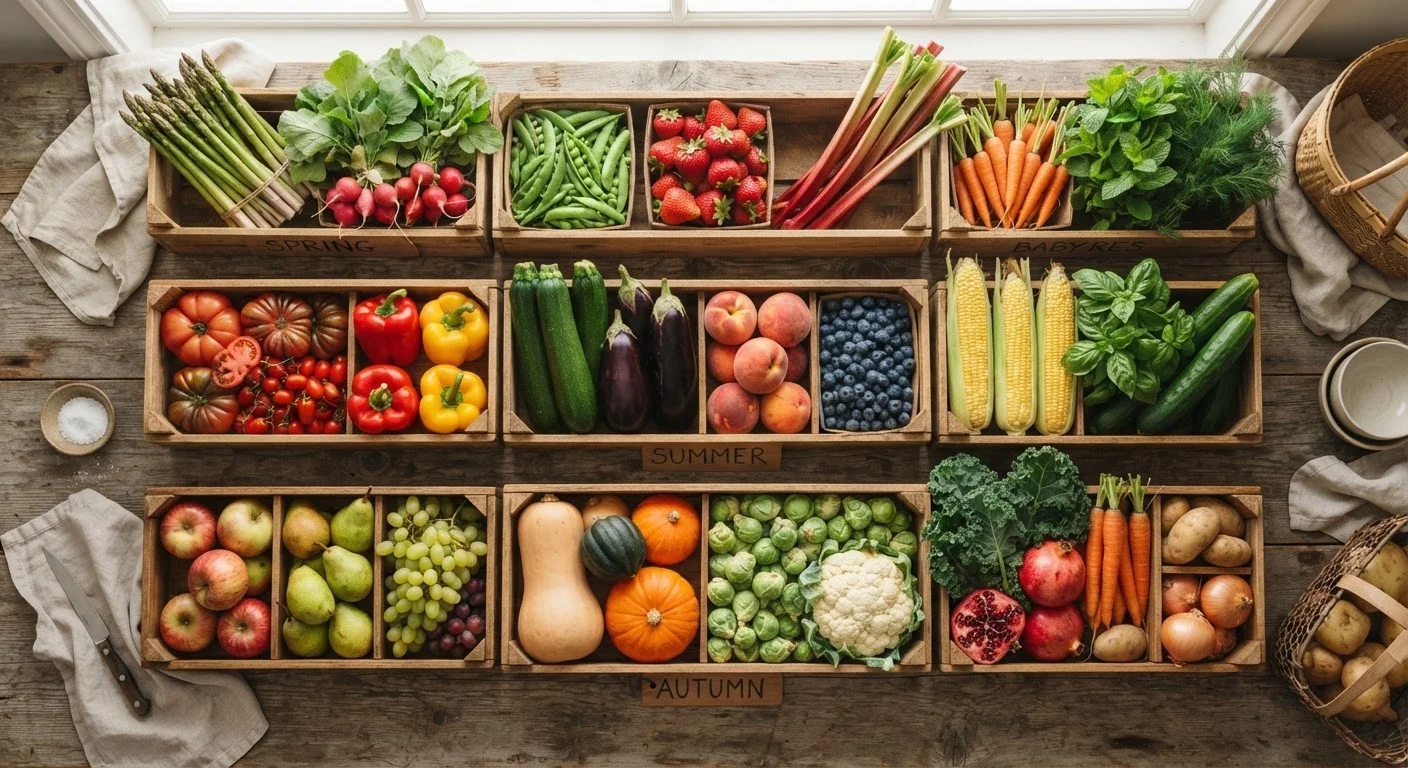
Photo: connectedsearches.com editorial
Key Takeaways
- Produce prices fall when local or regional harvest peaks because supply rises and shipping costs drop.
- Most crops have a predictable 4-to-12-week window of peak availability that repeats annually.
- Buying in-season and preserving by freezing or canning extends the savings into off-season months.
- A seasonal calendar used alongside a meal plan reduces both food costs and household waste.
- Frozen vegetables are harvested and processed at peak season, so they often carry the same cost advantage year-round.
How growing cycles drive grocery prices
Grocery store prices for produce are not arbitrary. They follow supply and demand patterns rooted in agriculture. When a crop is in peak harvest, the supply chain is flooded with product. Farmers sell quickly to avoid spoilage, regional distribution costs are low, and retailers compete on price to move volume. When the same crop is out of season domestically, it arrives from distant growing regions or climate-controlled greenhouses, both of which add measurable cost before the item reaches your cart.
The price difference can be substantial. Tomatoes in August, sourced from regional farms, typically cost a fraction of what the same weight costs in February, when they travel from Mexico or Florida greenhouses. The same pattern holds for corn, peaches, berries, summer squash, and asparagus. Cold-weather crops flip the equation: cabbage, Brussels sprouts, and root vegetables are cheapest in fall and early winter.
Understanding this cycle does not require any specialized knowledge. It requires knowing roughly when your region harvests its main crops, which is information your state's cooperative extension service publishes for free.
National vs. regional calendars
Reading a seasonal produce calendar
A seasonal produce calendar organizes crops by month and indicates whether each item is in early season, peak, or late harvest for a given region. Peak months are when prices tend to be lowest and quality tends to be highest because crops are picked at full ripeness rather than early to survive long transport.
Most calendars use a grid format: crops on one axis, months on the other. Some are color-coded by availability intensity. The most useful ones are state-specific because growing zones vary widely. A national chart averages out those differences and can mislead shoppers in northern states about what is actually cheap and available locally in, say, April.
The practical step is to check your calendar before writing your weekly shopping list, not after. If you decide on a recipe first and then check prices, you have already lost the cost advantage. Meal planning built around seasonal availability reverses that order and compounds the savings week over week.
4-12 weeks
Typical peak harvest window for most crops
Most vegetables and fruits reach their lowest price point during a concentrated harvest window that repeats on the same annual schedule each year.
40%+
Potential price premium for out-of-season fresh produce
USDA Economic Research Service analyses have documented significant price premiums for fresh produce sourced from distant regions or greenhouses outside the local growing season.
50 states
States with free extension office harvest calendars
Every US state has a land-grant university cooperative extension service that publishes regionally specific crop availability guides at no cost to consumers.
Preserving peak-season produce to extend savings
The lowest prices occur during a window of 4 to 12 weeks for most crops. Shoppers who buy in larger quantities during that window and preserve the excess can hold onto the cost advantage well into off-season months. The three most practical methods for home use are freezing, canning, and pickling.
Freezing is the lowest-effort option for most vegetables and many fruits. Blanching vegetables briefly before freezing halts enzyme activity and preserves texture. Berries, sliced stone fruits, and many vegetables freeze well without any pre-treatment beyond washing and drying. Frozen produce you process yourself carries no packaging premium and costs only what you paid at peak-season prices.
Home canning requires more equipment and attention to food safety protocols, particularly for low-acid vegetables, which need pressure canning rather than water-bath methods. For families new to canning, the National Center for Home Food Preservation publishes tested, research-backed recipes and safety guidelines at no cost.
One caution: buying large quantities to preserve only saves money if the produce actually gets used. Spoilage before processing is a common reason well-intentioned bulk seasonal purchases backfire. See budget cooking habits that quietly increase costs for a fuller look at that pattern.
When frozen produce fills the gap
Frozen vegetables are harvested at peak season and processed within hours, so they carry the same supply-chain cost advantage as fresh in-season produce, but year-round. For out-of-season months, frozen peas, corn, spinach, green beans, and mixed vegetables are generally less expensive per serving than their fresh counterparts shipped from distant regions.
The nutritional case for frozen is also sound. Most water-soluble vitamins are preserved by flash freezing, and in some cases frozen produce retains more nutrients than fresh produce that has spent several days in transit and on shelves. The nutritional comparison between frozen and fresh vegetables covers that evidence in detail.
Using frozen produce strategically, meaning for cooked applications where texture differences matter less, lets a household maintain variety and nutrition through winter without paying off-season fresh prices. Stir-fries, soups, casseroles, and grain bowls are all well-suited to frozen vegetables.
Putting a seasonal strategy into practice
The practical version of seasonal shopping does not require memorizing every harvest date. It requires two habits: checking a regional calendar once at the start of each month and writing your produce list based on what is in or approaching peak season.
A simple approach is to identify two or three vegetables and one or two fruits that are in peak season this month in your region, then build at least half your produce meals around those items. Supplement with frozen vegetables for variety and with cold-storage staples (carrots, onions, garlic, potatoes) that are available affordably year-round.
Over a full year, this approach reshapes your grocery spending in a consistent direction. It also tends to reduce waste because you are buying items at their freshest point rather than at the tail end of a long cold chain. If your household is already tracking grocery spending and noticing unexplained increases, understanding why grocery bills creep up identifies the other patterns worth examining alongside produce costs.
Frequently Asked Questions
The content provided on our blog site traverses numerous categories, offering readers valuable and practical information. Readers can use the editorial team’s research and data to gain more insights into their topics of interest. However, they are requested not to treat the articles as conclusive. The website team cannot be held responsible for differences in data or inaccuracies found across other platforms. Please also note that the site might also miss out on various schemes and offers available that the readers may find more beneficial than the ones we cover.