
Understanding Your Home's Water Shutoffs, Circuit Breakers, and Gas Valves

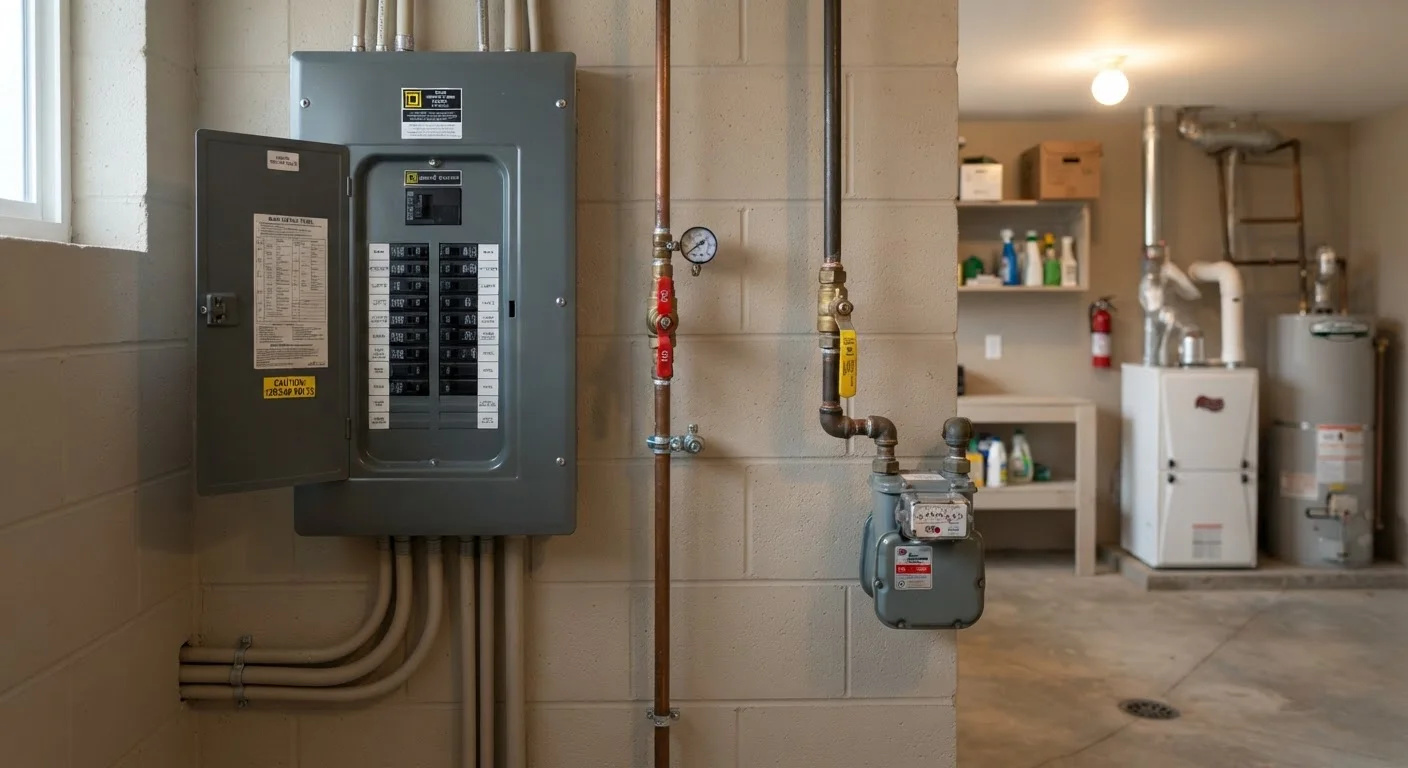
Photo: connectedsearches.com editorial
Why locating your shutoffs matters
A burst pipe, a tripped breaker that will not reset, or the smell of gas near an appliance are all situations where you need to act in seconds, not minutes. Homeowners who already know where their shutoffs are and how to operate them can stop damage before it spreads. Those who have to search during an emergency often pay for it, in water damage, electrical hazard, or gas accumulation.
This reference covers the three main control systems in a typical U.S. home: water shutoffs, circuit breakers, and gas valves. For each one, you will find where to look, how it works, and what the limits of homeowner action are. See our guide to DIY versus professional repairs for a broader look at which tasks to handle yourself and which to hand off.
Water shutoffs: main and fixture-level
Every home has at least two categories of water shutoff: a main shutoff that stops all water entering the house, and individual fixture shutoffs that isolate a single toilet, faucet, or appliance.
Main water shutoff
The main shutoff is usually within a few feet of where the water supply line enters the foundation. In colder climates this is often in a basement or utility room. In warmer regions it may be in a crawl space, an exterior wall cabinet, or near the water meter at the street. Your water utility can confirm the location if you cannot find it.
Two valve types are common. A gate valve has a round wheel handle; turn it clockwise (right) until it stops to close. A ball valve has a lever handle; rotate the lever a quarter turn so it is perpendicular to the pipe to close. Ball valves are faster and generally more reliable after years of inactivity.
Fixture shutoffs
Under every sink and behind every toilet there should be a small oval or football-shaped valve on the supply line. Turn it clockwise to close. These let you stop water to one fixture without cutting supply to the whole house, which is useful for a slow faucet drip or a running toilet.
If your home is older, these valves may be corroded and difficult to turn. Do not force them. A plumber can replace a frozen shutoff valve for a modest cost, and having a functional one is worth it. For context on what routine plumbing maintenance costs, see what home maintenance actually costs.
Circuit breakers: what they do and how to read the panel
Your electrical panel (sometimes called the breaker box or load center) contains one main breaker that controls all power to the home, and a row of individual breakers for each circuit. The panel is most often mounted on an interior wall in a utility room, garage, basement, or hallway. Federal law requires it to be accessible and unobstructed.
Reading the panel
Each breaker should be labeled to show which room or appliance it controls. If yours are not labeled, turn on lights and appliances in each room and flip breakers one at a time to map them. Write the labels in pencil on the inside of the panel door. A clear map saves time during any outage.
Resetting a tripped breaker
A tripped breaker sits in a middle position between ON and OFF. To reset it, push it firmly to OFF first, then back to ON. If it trips again immediately, the circuit is overloaded or there is a fault. Do not keep resetting it. Unplug devices on that circuit and try once more. If it trips a second time with nothing plugged in, contact a licensed electrician. Repeated tripping can signal wiring damage.
Never attempt to replace, rewire, or modify breakers yourself. That work requires a permit and a licensed electrician in nearly every U.S. jurisdiction. The main breaker panel involves voltages that can cause fatal injury even when individual breakers are off.
Main shutoff
A single valve or switch that stops the supply of water, electricity, or gas to the entire home. Operating it affects all fixtures or circuits downstream.
Ball valve
A type of water or gas shutoff with a lever handle. A quarter turn closes the valve completely. Preferred over gate valves because they seal reliably even after long periods of no use.
Gate valve
A shutoff valve with a round wheel handle that must be turned multiple times to open or close fully. Common in older homes and more prone to corrosion.
Circuit breaker
A protective switch in the electrical panel that automatically cuts power to a circuit when current exceeds a safe level. It can be manually reset after the overload is resolved.
Load center
Another name for the electrical panel or breaker box. It distributes power from the utility to individual circuits throughout the home.
Appliance shutoff
A dedicated valve or breaker that isolates a single appliance (such as a water heater, range, or washer) from its supply line, without cutting service to the rest of the home.
Gas valves: main shutoff and appliance shutoffs
Natural gas and propane supply lines each have shutoffs at multiple points. You should know at least two: the main shutoff and the individual appliance shutoffs.
Main gas shutoff
The main gas shutoff is typically on the gas meter, which is outside the home on an exterior wall or in a utility alcove. The shutoff valve is a rectangular tang (a small flat fitting) on the pipe. When the tang is parallel to the pipe, gas flows. When perpendicular, gas is off. You need a crescent wrench or a dedicated gas shutoff tool to turn it. Keep one near your meter or in your emergency kit.
Do not shut off the main gas valve unless you smell gas, suspect a leak, or are directed to by your gas utility. Once shut off, the gas company must perform an inspection and relight pilot lights before service is restored. That requirement protects safety but means restoring service can take time.
Appliance shutoffs
Most gas appliances (water heater, furnace, range, dryer) have a dedicated shutoff valve on the supply line within a few feet of the unit. It operates the same way as the main valve: parallel to pipe means open, perpendicular means closed. You can use these to isolate a single appliance without cutting gas to the whole house.
If you smell gas
Leave the building immediately without operating any switches or electronics. Do not use your phone inside. Call your gas utility's emergency line from outside or from a neighbor's home. Do not re-enter until the utility clears the building. This is not a situation for homeowner diagnosis or repair. For more on building a complete home maintenance plan, see the first-time homeowner routine upkeep guide.
The content provided on our blog site traverses numerous categories, offering readers valuable and practical information. Readers can use the editorial team’s research and data to gain more insights into their topics of interest. However, they are requested not to treat the articles as conclusive. The website team cannot be held responsible for differences in data or inaccuracies found across other platforms. Please also note that the site might also miss out on various schemes and offers available that the readers may find more beneficial than the ones we cover.