
Stacking Savings: Combining Coupons, Cashback, and Store Sales Without Getting Tripped Up

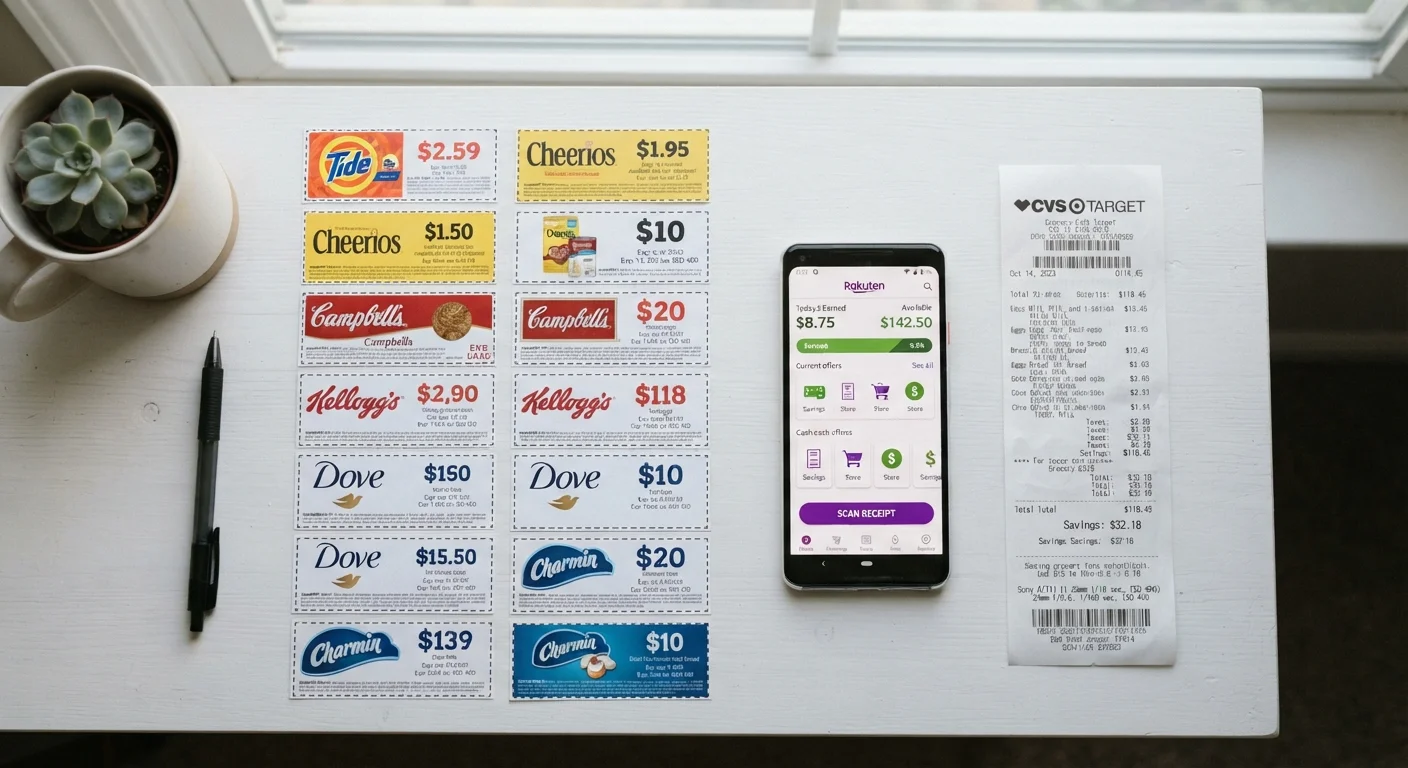
Photo: connectedsearches.com editorial
Key Takeaways
- Most stores allow one manufacturer coupon and one store coupon on the same item, but policies vary.
- Cashback portals and apps typically stack on top of coupons and sale prices without voiding either.
- Reading a store's coupon policy before shopping prevents rejected coupons and checkout frustration.
- Buying only what you would use anyway is the baseline test for whether a stacked deal is worth taking.
- Digital loyalty coupons and paper manufacturer coupons can often be combined at the same register.
How discount stacking actually works
Stacking discounts means applying more than one savings mechanism to a single purchase. In practice, a transaction might involve a manufacturer coupon, a store loyalty coupon, a sale price, and a cashback reward, all on the same item. Each layer reduces the amount you pay or returns money afterward, and they do not automatically cancel each other out.
The concept is straightforward, but the rules governing which layers can coexist are set by individual retailers and coupon issuers. Understanding those rules is what separates a smooth checkout from a frustrating one. If you are new to this area, this family-friendly primer covers the core vocabulary before you go further.
There are three broad savings categories you can layer. First, manufacturer coupons: issued by the product's maker, redeemable at most retailers. Second, store coupons: issued by the retailer itself, valid only at that chain. Third, cashback rewards: money returned after purchase through an app, portal, or credit card program. A sale price sits underneath all of these as the starting point.
Cashback does not reduce checkout price
Cashback works differently from coupons because it does not reduce the price at the register. The retailer charges full (or coupon-adjusted) price, and the cashback platform reimburses you separately. This means cashback rarely conflicts with coupon policies.
What stores actually permit
No universal rule governs all retailers. Each chain publishes a coupon policy, usually on its website, and that document is the authority. Common patterns across many grocery chains include: one manufacturer coupon per item, one store coupon per item, and unlimited sale prices. Combining a manufacturer coupon with a store coupon on the same item is called coupon stacking, and a majority of large grocery chains allow it, though some do not.
Wholesale clubs and drug chains often have distinct rules. Some prohibit manufacturer coupons entirely on certain membership-priced items. Others allow stacking but cap the total discount at the item's price so the transaction cannot go below zero. Checking the policy once, before your first trip to a new store, takes about five minutes and prevents repeated problems at checkout.
Digital coupons loaded to a loyalty account follow the same logic as paper equivalents. A digital store coupon and a paper manufacturer coupon can typically stack if the retailer's policy permits both coupon types on one item. This guide to digital coupons explains how loyalty-linked offers work mechanically and where they tend to expire or duplicate.
Common stacking mistakes that cause coupons to be rejected include: presenting two manufacturer coupons for one item, using a coupon for a size or variety the item does not match, and applying a coupon after its expiration date. These missteps are covered in detail here if you have had repeated rejections without a clear reason.
Step-by-step: building a stacked savings plan
Read the store's coupon policy
Search for the retailer's name plus "coupon policy" before your first shopping trip. Look for answers to three questions: does the store allow stacking manufacturer and store coupons on one item, does it accept digital coupons alongside paper ones, and is there a limit on the total discount per item or transaction?
Start with the sale price
Pull up the store's weekly circular or app to identify items on sale that you were already planning to buy. A sale price is the foundation every other discount builds on. Targeting sale items first ensures you are not purchasing something solely because a coupon exists for it.
Layer your manufacturer coupon
Search the product's manufacturer website, coupon aggregator sites, or the Sunday print insert for a manufacturer coupon matching the exact item size and variety on sale. Verify the expiration date and any quantity requirements before adding it to your plan.
Add the store or loyalty coupon
Check the store's app or loyalty account for a store coupon on the same item. If one exists and the store's policy allows stacking, load it to your account or clip it. Confirm that the coupon applies to the same size and quantity you are purchasing.
Attach a cashback offer
Open your cashback app or portal and search for the product or store. If an offer exists, activate it before the purchase. Most apps require activation in advance; cashback is not applied retroactively if you forget to activate first.
Verify at checkout
At the register, watch the screen as each coupon scans. If a coupon does not apply, ask the cashier before completing the transaction. Common causes are a mismatched item size, a duplicate coupon type, or a loyalty account that was not recognized. Having the store's policy accessible on your phone gives you a reference if a dispute arises.
Cashback tools and how they fit in
Cashback portals work by tracking your purchase and paying a percentage back, usually within days or weeks. Because the payment happens after checkout, they do not interfere with coupon validation at the register. This makes them compatible with almost every coupon-and-sale combination, provided the portal covers the retailer or product category.
Two main types exist: store-specific apps (often tied to a loyalty account) and general cashback apps that cover multiple retailers. Some credit cards also provide category-level cashback, such as a fixed percentage back on all grocery spending. These can all apply to the same transaction simultaneously.
The one conflict to watch: some cashback platforms have terms that exclude purchases already discounted by more than a set percentage, or they exclude specific promotional categories. Reading the offer terms before assuming it applies takes less than a minute. This comparison of browser extensions and cashback apps walks through when each tool tends to produce better results so you can decide which to prioritize.
For your weekly grocery routine, a pre-trip habit of cross-checking available coupons and cashback offers can cut preparation time significantly. This weekly prep checklist gives a repeatable structure for doing exactly that.
The content provided on our blog site traverses numerous categories, offering readers valuable and practical information. Readers can use the editorial team’s research and data to gain more insights into their topics of interest. However, they are requested not to treat the articles as conclusive. The website team cannot be held responsible for differences in data or inaccuracies found across other platforms. Please also note that the site might also miss out on various schemes and offers available that the readers may find more beneficial than the ones we cover.