
Net Income, Gross Income, and Take-Home Pay: A Plain-Language Reference

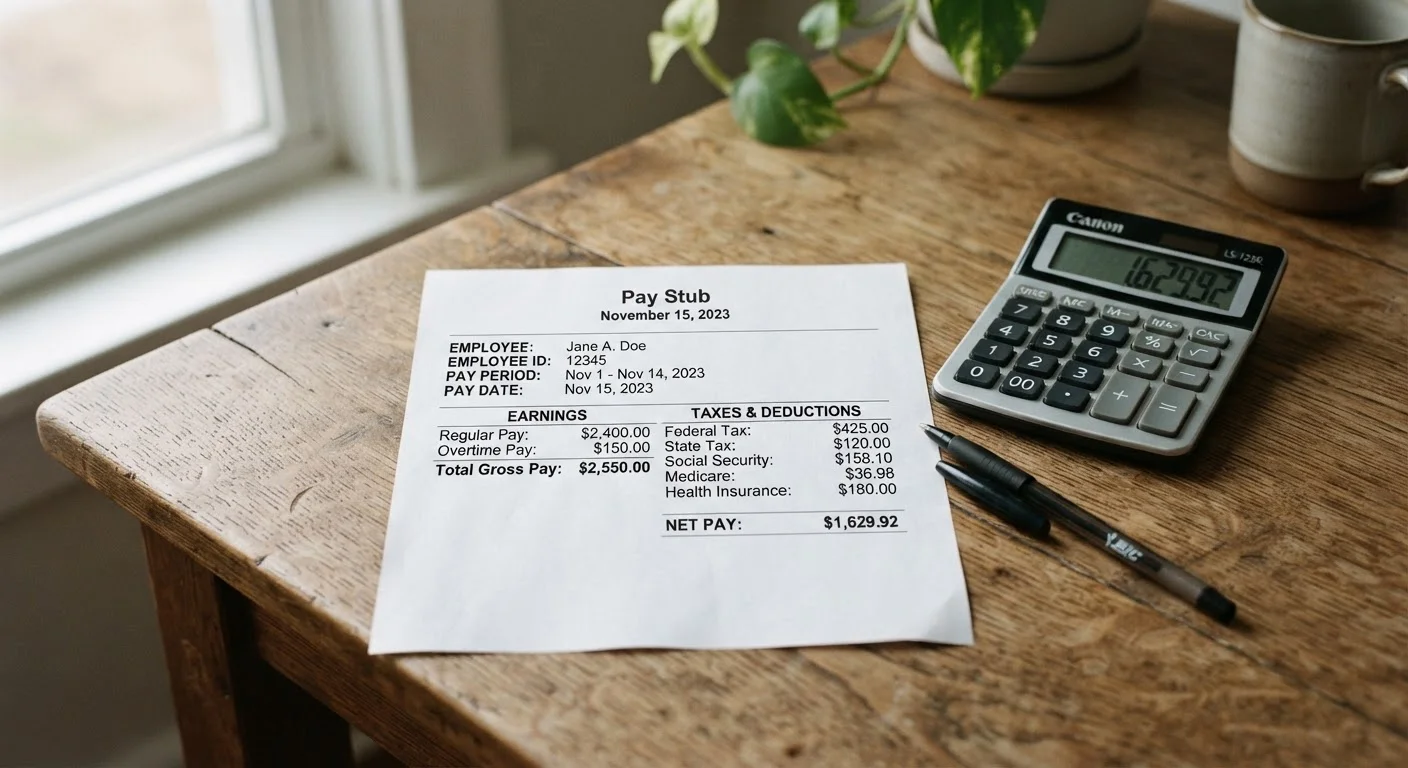
Photo: connectedsearches.com editorial
What these three terms actually mean
Most Americans see the words "gross" and "net" on their pay stubs every pay period, but the difference between them is not always spelled out. Here is a plain-language breakdown.
Gross income is your total earnings before anything is taken out. If your employer agreed to pay you $50,000 a year, that figure is your gross salary. On a biweekly paycheck, your gross pay is simply that annual amount divided by 26.
Net income is what remains after federal income tax, state income tax (where applicable), Social Security tax, Medicare tax, and any other mandatory withholdings are subtracted from gross. For employees, this number appears on the pay stub as "net pay."
Take-home pay is a common informal phrase. For most wage earners, it means the same thing as net pay: the dollar amount deposited to your bank account or printed on your check. In some contexts, financial writers use "take-home pay" to signal that voluntary deductions, such as retirement contributions and health insurance premiums, have also been removed. Because usage varies, it is worth confirming which definition your employer or financial resource is using.
Gross income
Total earnings before any taxes or deductions are removed. For a salaried employee, this is the figure stated in the employment agreement.
Net income
Earnings remaining after all mandatory taxes and withholdings are subtracted from gross income. This is the amount shown as 'net pay' on a pay stub.
Take-home pay
An informal term for the money you actually receive, usually equivalent to net pay. Some sources also subtract voluntary deductions such as retirement contributions before using this term.
Pre-tax deduction
A voluntary deduction, such as a 401(k) contribution or HSA deposit, that is subtracted from gross income before federal income tax is calculated, reducing the amount of income subject to tax.
Withholding
The portion of your paycheck your employer sends directly to the IRS and state tax agencies on your behalf. The amount is based on your W-4 elections and current tax rates.
Self-employment tax
The combined Social Security and Medicare tax paid by self-employed individuals. It totals 15.3% on net self-employment earnings up to the Social Security wage base, because there is no employer to split the cost.
This article is for general informational purposes only and is not personalized financial, tax, or legal advice. Consult a qualified tax professional or licensed financial adviser for guidance specific to your situation.
How deductions shrink gross pay
The gap between gross and net pay comes from two categories of deductions: mandatory and voluntary.
Mandatory deductions
- Federal income tax: withheld based on the W-4 form you filed with your employer and the IRS tax brackets for your filing status.
- Social Security tax: a flat 6.2% of wages up to the annual wage base, which the IRS adjusts periodically.
- Medicare tax: a flat 1.45% on all wages, with an additional 0.9% on wages above $200,000 for single filers.
- State and local income tax: varies by location; some states have no income tax at all.
Voluntary deductions
- Contributions to a 401(k) or 403(b) retirement account
- Health, dental, and vision insurance premiums
- Health savings account (HSA) or flexible spending account (FSA) contributions
- Life or disability insurance premiums offered through an employer plan
Voluntary deductions that are "pre-tax" reduce the portion of your gross income that is subject to federal income tax, which is why retirement contributions can lower your tax bill even while reducing your take-home amount.
| Social Security tax rate (employee share) | 6.2% of wages up to the annual wage base (IRS Publication 15) |
| Medicare tax rate (employee share) | 1.45% on all wages (IRS Publication 15) |
| Additional Medicare tax threshold (single filers) | 0.9% on wages above $200,000 (IRS) |
| Self-employment tax rate (combined) | 15.3% on net self-employment income up to the wage base (IRS Schedule SE) |
| States with no individual income tax | 9 states as of 2024 (Tax Foundation, 2024) |
| Standard W-4 form used for | Telling your employer how much federal income tax to withhold (IRS) |
Why this matters for a household budget
A budget built on gross income instead of take-home pay will consistently fall short. If your household gross salary is $75,000, your actual spendable income might be closer to $57,000 to $62,000 depending on your state, filing status, and benefit elections. Planning around the higher number leads to overdrafts, credit card reliance, and missed savings goals.
When you compare two job offers, the gross salary figures are a starting point, not the whole picture. A position in a state with no income tax can produce meaningfully higher take-home pay than an identical salary in a high-tax state. Similarly, an offer with employer-paid health insurance reduces the voluntary deductions you will owe, raising your net pay even if the gross number looks smaller.
For freelancers and self-employed workers, the math is different. There is no employer withholding, so gross business income arrives without deductions. Self-employed individuals generally pay both the employee and employer share of Social Security and Medicare taxes (totaling 15.3% on net self-employment income up to the wage base), and must make estimated tax payments quarterly. Budgeting on gross income without setting aside a tax reserve is a common and expensive mistake.
The content provided on our blog site traverses numerous categories, offering readers valuable and practical information. Readers can use the editorial team’s research and data to gain more insights into their topics of interest. However, they are requested not to treat the articles as conclusive. The website team cannot be held responsible for differences in data or inaccuracies found across other platforms. Please also note that the site might also miss out on various schemes and offers available that the readers may find more beneficial than the ones we cover.