
Debt Snowball vs. Debt Avalanche: How Families Choose a Payoff Strategy

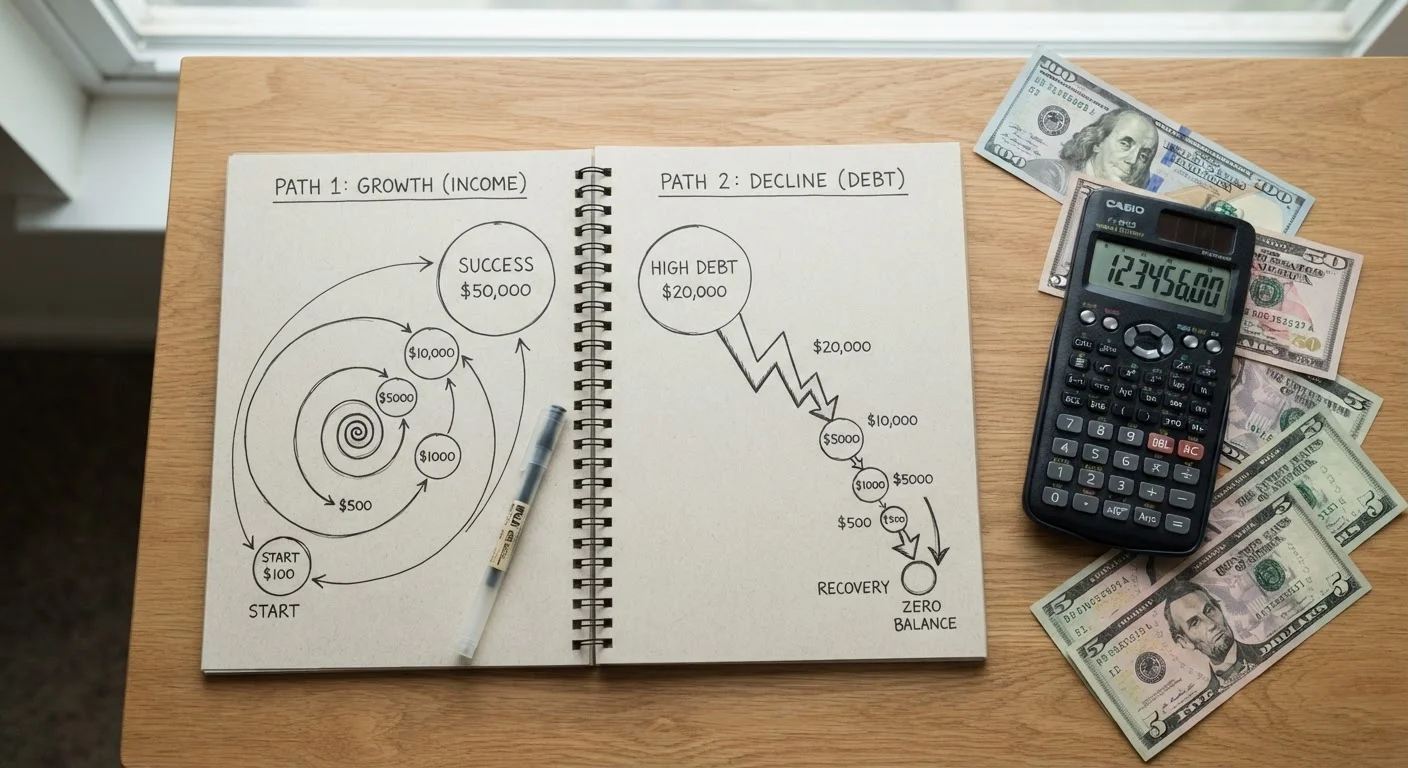
Photo: connectedsearches.com editorial
Key Takeaways
- The debt snowball pays off the smallest balance first, regardless of interest rate.
- The debt avalanche targets the highest interest rate first to reduce total interest cost.
- The snowball typically costs more in interest but can be easier to stick with long-term.
- The avalanche saves the most money on paper but requires patience before seeing early payoff milestones.
- Both methods work only when you stop adding new debt while paying down existing balances.
- Your household's budget, personality, and number of accounts all influence which method fits better.
How each strategy works
Both methods share the same mechanical backbone. You make minimum payments on every account each month, then direct any extra money you can spare toward one target account. Once that account is paid off, you roll its payment amount into the next target. The strategies differ only in how you rank the targets.
With the debt snowball, you list your debts from the smallest current balance to the largest and work through them in that order. A $400 medical bill gets attacked before a $3,000 credit card, even if the credit card carries a higher interest rate.
With the debt avalanche, you list debts by interest rate, highest to lowest, and attack them in that order. A credit card at 24% annual percentage rate (APR) comes before a personal loan at 11% APR, regardless of which balance is larger.
| Criterion | Debt Snowball | Debt Avalanche |
|---|---|---|
| Payoff order | Smallest balance first | Highest interest rate first |
| Total interest paid | Generally higher | Generally lower |
| Time to first full payoff | Faster (smallest account) | Slower if high-rate debt is large |
| Motivation factor | Early wins build momentum | Requires patience upfront |
| Math complexity | Simple balance ranking | Requires knowing each APR |
| Best condition | Rates are similar across accounts | One account has a much higher rate |
This article is general financial information and education, not personalized financial advice. Consult a licensed financial professional for guidance specific to your situation.
The real cost difference
The avalanche saves money in interest, and the gap can be meaningful depending on your balances and rates. A household with $15,000 spread across three credit cards at rates between 18% and 26% could pay hundreds less in interest by targeting the 26% card first, compared with paying off the smallest balance first.
The snowball costs more in total interest because high-rate balances sit untouched longer, compounding while you clear smaller accounts. However, the dollar difference between the two methods narrows when balances are similar in size or when rates are clustered close together.
~$1,000+
Potential interest difference between methods
Consumer Financial Protection Bureau educational materials indicate that repayment order can shift total interest costs by hundreds to over a thousand dollars on typical household debt loads, depending on balances and rates.
3 in 10
U.S. adults carrying credit card debt month to month
Federal Reserve survey data consistently shows roughly 30% of American adults carry a revolving credit card balance, making repayment strategy a relevant decision for a large share of households.
Neither method produces savings automatically. Both require a consistent extra payment each month. Without that extra payment, you are only making minimums, which is the most expensive way to carry debt regardless of which account you prioritize.
Behavioral trade-offs families should weigh
Personal finance research, including work published by consumer behavior academics, has found that some households pay down debt faster when they use the snowball, even though it costs more in interest. The reason appears to be motivation: completing a full payoff, even on a small account, increases confidence and commitment to the plan.
The avalanche demands patience. If your highest-rate debt also carries the largest balance, you may not close a single account for a year or more. For households that have struggled to follow through on financial plans, that long runway without a visible win can lead to abandoning the strategy entirely.
Your household's number of accounts matters too. If you have only two debts, the difference between methods is smaller because there are fewer accounts to sequence. If you have six or seven accounts, the ordering decision has more impact on both motivation and interest cost.
A few practical considerations before choosing
Check whether any accounts have promotional zero-interest periods ending soon. A balance that carries no interest today but shifts to 29% APR in four months deserves attention regardless of which method you prefer. That kind of deadline can override the normal ranking in either strategy.
Some families combine elements of both. They start with the snowball to eliminate one or two small accounts, which reduces the number of minimum payments they must juggle each month. Once those are gone, they switch to avalanche ordering for the remaining balances. This hybrid has no formal name, but it works for households that need an early win without abandoning the interest-savings logic entirely.
Whatever method you choose, the starting point is the same: a written list of every balance, its minimum payment, and its interest rate. Without that list, neither strategy can be applied consistently.
The content provided on our blog site traverses numerous categories, offering readers valuable and practical information. Readers can use the editorial team’s research and data to gain more insights into their topics of interest. However, they are requested not to treat the articles as conclusive. The website team cannot be held responsible for differences in data or inaccuracies found across other platforms. Please also note that the site might also miss out on various schemes and offers available that the readers may find more beneficial than the ones we cover.